Estimated reading time: 6 minutes

You can learn to manage painful emotions through mindfulness. Human beings are emotional creatures. We all have painful as well as pleasant emotions. We also have emotions which are “neutral”. These are neither pleasant or painful, according to neuroscience and Buddhist philosophy.
The good news is that you can learn to cultivate a more considered way of dealing with emotions, both the pleasant and painful emotions. Learning to manage painful emotions through mindfulness is a valuable life skill, useful in all your relationships: at home, at work and in your communities.
Mindfulness in intimate relationships
Neuroscience and modern psychology are now able to explain what philosophy and spiritual teachings throughout the ages has been advising – that the key to managing painful emotions in relationships is mindfulness.
Feelings and emotions guide your behaviours and responses to life and relationships. You can learn to do this in conscious ways by combining reason, emotion and awareness. Even big emotions like anger and jealousy. You can learn to witness feelings, emotions and thoughts by using the techniques of mindfulness. That helps you not be so thrown by emotions.
Or you can remain reactive, driven by your unconscious, knee-jerk responses to life’s challenges. The choice is yours.
There are no bad emotions
Emotions are not bad. Emotions are valuable sources of information. It’s what you do with the information they give you which is the key to having successful relationships at home and at work.
We all perceive some emotions are being more pleasant than others and want to hold on to the pleasant emotions and escape from unpleasant or painful emotions. Evolutionary biology shows us that seeking pleasure and escaping from pain is wired into our nervous systems. These are our primitive, instinctive, reactive, knee-jerk responses to pleasure and pain.
Yet you can learn to manage painful emotions. There are modern adaptations of ancient techniques of mindfulness. But takes practice, repetition and time to become adept at using them.
It is recommended to learn to manage your own emotions first. One way of doing this is by learning self-compassion – a crucial skill according to Kristin Neff. Contrary to popular belief, this is not selfish. It is self-full in a healthy way. Self-compassion helps you to experience the difference between responding mindfully and patiently versus reacting mindlessly and automatically.
Once you have a good enough sense of how to do that for yourself, you can extend mindful compassion to others. Then you can more easily be kind, patient and compassionate with your partner.
Manage Painful Emotions Through Mindfulness
When you cultivate the practice of mindfulness, it enables you to self-soothe and calm down. Use any techniques that work for you. Try to use as many of your senses as possible to ground you in the present. Notice what you see, hear, smell, taste or touch. When you’re calm, you have more space to think, feel and respond with forethought, instead of reacting instinctively and impulsively.
Following the six steps below will help you to understand and manage your painful emotions through mindfulness.
6 Steps to Mindfully Deal with Painful Emotions
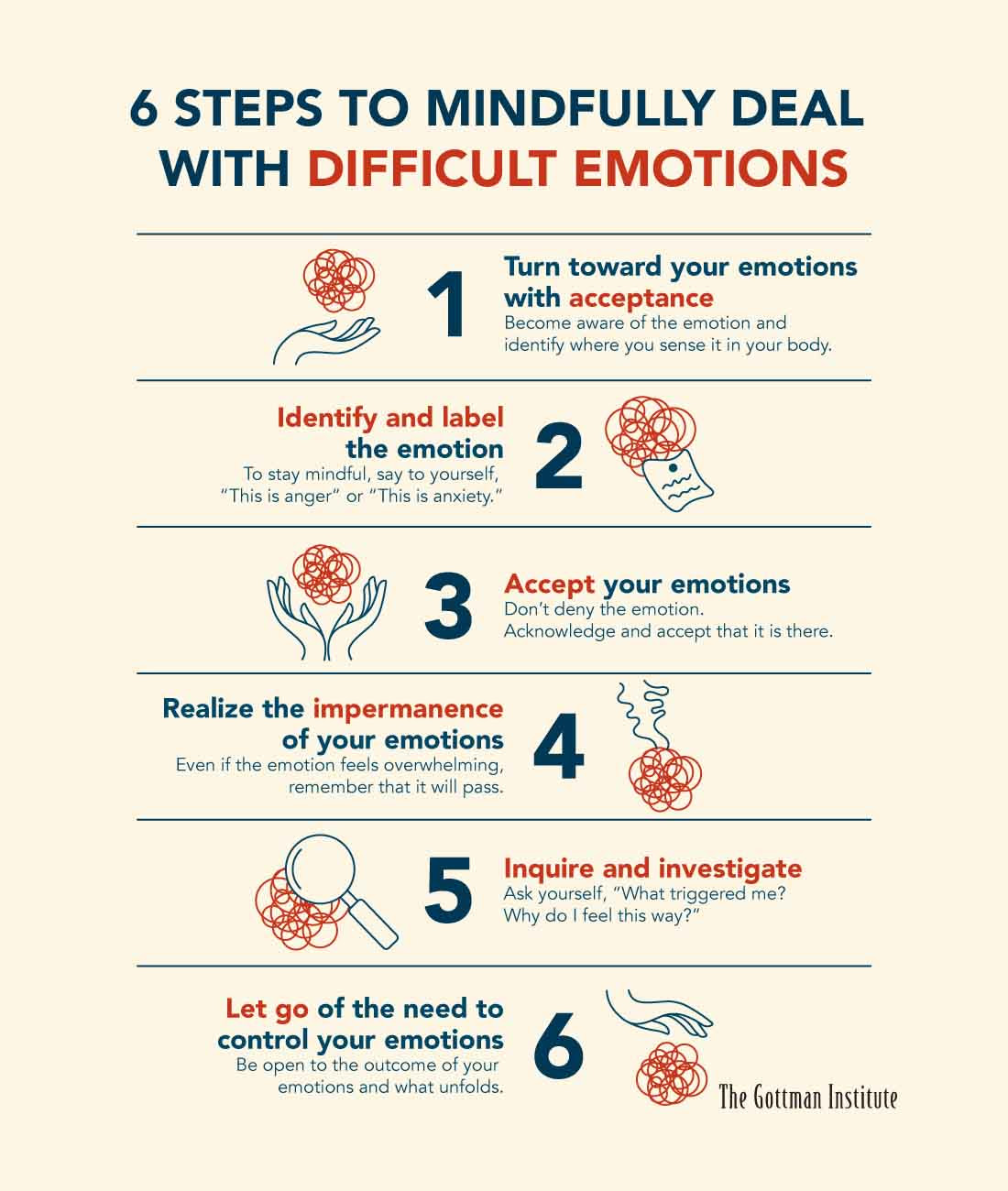
You can 6 Steps to Mindfully Deal with Difficult Emotions poster is here
Emotions according to neuroscience, psychology, philosophy and spirituality
Much research has been done on mindfulness, empathy and the neurobiology of relationships. Neuroscientist Antonio Damasio explains how our minds emerge from emotions and feelings. He says that feelings, (sensations in the body) and emotions (physical states coming from our body’s responses to stimuli) are central to the life-regulating processes of almost all living creatures.
By studying brain-damaged patients Damasio showed that they were unable to make good decisions because their emotions were impaired, even though their reasoning was undamaged.
Making good choices and avoiding bad choices is difficult. When making any big decision, like committing to a partner, there is always a chance that things won’t work out as we hope. Affective neuroscience shows that it’s critical to be able to judge (via thinking) what risks are worth taking – and emotions can help us make those judgments. Thinking, feelings and emotion inform each other.
Our physical, emotional, mental, social, cultural and spiritual contexts have multi-directional, interacting effects on how we behave. There is a complex interplay of factors behind our awareness of emotions. Psychiatrist Iain McGilchrist shows that “…the mind and brain can be understood only by seeing them in the broadest possible context, that of the whole of our physical and spiritual existence, and of the wider human culture in which they arise – the culture which helps to mould, and in turn is moulded by, our minds and brains”. His famous YouTube video summarizes his views.
Theories of emotion
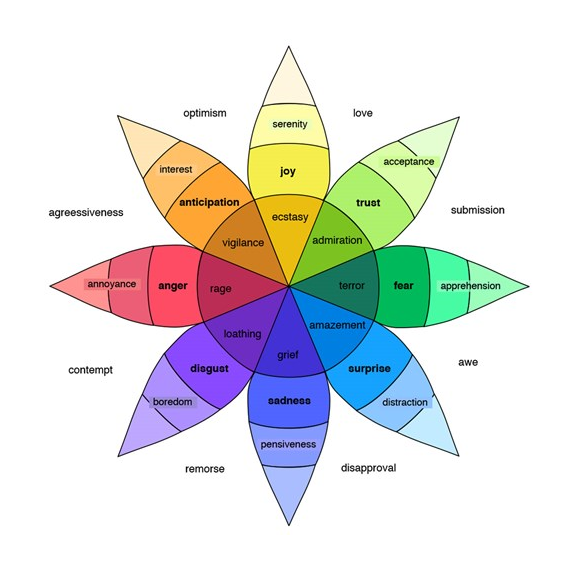
There are many theories of emotion and different views on the number basic emotions. Paul Ekman identified six universally recognised facial expressions of emotion. And Robert Plutchik suggested that we have eight primary bipolar emotions and created a wheel of emotions to show them: joy versus sadness; anger versus fear; trust versus disgust; and surprise versus anticipation.
Stephen Batchelor my favourite teacher of secular Buddhism, uses the acronym ELSA – Embrace Life, Let Go, Stop Grasping, Act, as a structure for embracing life, letting go of reactivity, stopping grasping and cultivating a path of action by doing a sequence of tasks. This is mindfulness in action for the modern world, showing clear steps for managing painful emotions through mindfulness.
Sam Harris, neuroscientist, philosopher, and best-selling author also provides clear guidelines to spirituality without religion. Managing emotions, by using mindfulness practices, is central to cultivating a balanced approach to life and relationships.
Learning to manage painful emotions through mindfulness and cultivating mindfulness practices go hand in hand. They help us lead more aware, balanced and happy lives. If you’re interested in getting help in dealing with painful emotions call 0421 961 687 or email me to schedule an appointment. International callers should call +61 421 961 687.
You deserve the best trained relationship coaches if you’re planning to invest time and money in your relationship. If you’re not ready to book an appointment, call us on 0421 961 687 to book a FREE 15 minute phone consultation to discuss how we may be able to assist you. See my 3 eBooks on Amazon.

Leave a Reply