
Estimated reading time: 5 minutes
The importance of your intimate attachments and connections to others cannot be emphasised enough. John Bowlby, the father of attachment theory, studied attachments for his whole life. His opinion was that your intimate attachments to other human beings are the hub around which your life revolves.
His research, and that of his students Mary Ainsworth and Mary Main, showed that attachment patterns begin when we are infants. because of this, they can continue throughout life. But problematic attachment patterns can be changed and healed by learning emotional regulation skills, practicing self-soothing and learning emotion coaching skills.
Attachment styles
There are three main attachment styles, two of which may cause difficulties in relationships. Watch this 6.5 minute video by Alain de Botton explaining more about intimate attachments and attachment styles.
Your attachments, emotional ties and experiences with your carers and partners, influence your lifelong development. This begins in toddlerhood & continues into adolescence and into your old age. The good news is that you are not stuck with your conditioning forever. You can work on changing your reactions and ways of being in your intimate attachments. Doing this work is an opportunity to grow and evolve into becoming secure lovers and friends. In addition, this also helps you develop through the five stages of intimacy.
Social cues and neuroscience
Humans are social animals. As social animals you and me are “programmed” to automaticaly monitor our physical and emotional environment for safety and connection. This means we are wired for love, attachment and survival. We are constantly judging how available and responsive to us are our close and intimate attachments.
You do this all the time, mostly unconsciously. You monitor social cues like body language, eye contact, smiles, frowns, tone of voice, speed & loudness of speech etc. These non-verbal cues are signals of safety (connection) or threat (disconnection, disinterest) with others.
Most of what happens in your relationships occurs below your awareness. These unconscious cues drive your instantaneous and habitual responses based on what you “expect” will happen.
What this means is that you are not trapped by your past experiences. Current research in neuroscience and brain plasticity (the ability of the brain to change and grow in response to experience), demonstrates that healthy and fulfilling experiences in any relationships (friends, partners, counsellors) can “rewire” the brain. As a result, every experience we have is rewiring our brains, for the better or worse.
Neuroplasticity and intimate attachments
Neuroscience has shown us that the emotional parts of your brain are constantly scanning your environment, and the people with whom you interact, to check for emotional safety. This is a good thing, you need it for your survival. Your emotional brain does the best job possible to keep you safe. For example, it does this by checking that your carers (when you are a baby) and your partners and friends (when you are an adult) are responsive to you.
Your old, unconscious patterns of negative expectations and reactivity can gradually be replaced by current experiences of positive attachment. You can bring this about by practicing new ways of responding. Each time you do this, your brain is rewired so you develop new skills and new habits. The result is that you can then respond in new ways in relationships.
This is good news! It means that working on yourself and developing new habits like self-soothing, calming yourself down, relaxing your body, and noticing how you feel are fundamental skills. Read what Hal Shorey says about Finding a Secure Base and Rewiring Your Personality. Doing this self-soothing inner work many times daily through a process called deliberate practice brings about deep-seated, permanent change within you. These practices cultivate the ability for you to choose to respond instead of react to the many challenges in life and relationships.
Most importantly, you need to develop these skills so you can decide what to do and how to communicate to your partner in respectful and moderate ways. They make a big difference to your attachments and attachment styles. Doing this can assist your partner, friends and family to respond to you in more positive ways.
Above all it means that you have much more influence on how your intimate attachments play out. By being actively engaged in rewiring your brain and developing new experiences, you gain more self-esteem and personal empowerment along the way.
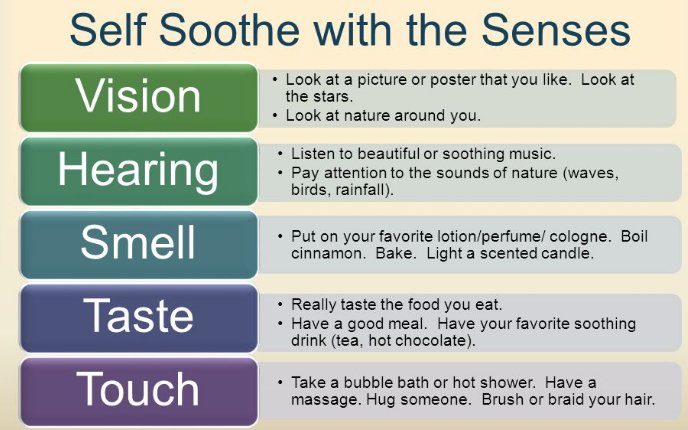
The image below shows how you can self-soothe with the senses.
If you need help in developing more intimate attachments in relationship, call 0421 961 687 or email us to schedule an appointment. International callers should call +61 421 961 687.
You deserve the best trained relationship coaches if you’re planning to invest time and money in your relationship. If you’re not ready to book an appointment, call us on 0421 961 687 to book a FREE 15 minute phone consultation to discuss how we may be able to assist you.

Leave a Reply